In late September 2026, Meta expanded Muse with Muse for Small Business: new skills and connectors so a small-business owner can point an AI agent at the tools they already use and get goals turned into drafts, plans, and queued actions (Meta Newsroom, Sep 29, 2026; TechCrunch).
That launch answers a real pain: you’re short on hours, not ideas. Muse’s bet is clear: connect everything you already run, then let an agent work across it (with you approving anything that publishes, sends, or spends).
Runza answers a different bet: for freelancers, coaches, consultants, and local service pros who are the company, the problem isn’t only “I need a smarter conductor.” It’s “I never wanted an eight-tool orchestra.” Ace, Runza’s AI co-founder who does the work, runs website, customers, invoicing, and marketing in one place, so you’re not wiring Shopify + QuickBooks + Canva + Slack + ads + a CRM just so an agent has somewhere to operate.
This page is a fit check. Not a dunk. When Muse’s orchestration layer is the right move, when Runza’s “be the stack” model fits better, what Muse users actually pay beyond the agent line, and how to decide without absorbing another platform career.


The core difference in one table
| Meta Muse | Runza | |
|---|---|---|
| Architecture | Orchestration layer, connects to tools you already use | The stack itself: site, CRM, invoices, marketing live in Runza |
| How work gets done | Agent works across connected apps (Shopify, QuickBooks, Canva, Slack, HighLevel, Stripe, Meta ads, etc.) | You describe the outcome; Ace helps do the jobs inside Runza |
| What you must bring | A working (or growing) multi-tool setup worth connecting | A one-person company that doesn't want to assemble that setup first |
| Frankenstack status | Makes the stack smarter, does not erase the stack | Designed to replace the Tuesday tax of 8 to 12 logins for solos |
| Control model | Nothing publishes / sends / spends without your approval; audit trail | Same spirit: Ace works with you, you're not handing the company keys to a black box |
| Best for | Owners who already live in Meta + Shopify/QB/Canva/Slack and want an agent on top | Owners who want one co-founder workflow, not one more connector map |
| Price posture | Agent: free / Power $20/mo / Maximum $100/mo, plus every connected tool's SaaS, usage, and ad spend | One clear Runza plan for the company OS, Pro is $69/mo with a 30-day trial |
Wedge: Muse connects to it all. Runza is it all, for the one-person company that shouldn’t need “it all” as eight products first.
Who this comparison is for
- Already run a real multi-app stack (storefront, books, design, chat, ads) and the pain is coordination, not existence of those systems
- Live daily inside Facebook Pages, Instagram professional, and Meta ads
- Want an agent that drafts campaigns, growth plans, and replies using data from tools you refuse to abandon
- Are fine maintaining connectors, credentials, and approval queues as the price of keeping best-of-breed apps
- Are a freelancer, coach, consultant, or local service pro who is the whole company
- Hear “connect Shopify, QuickBooks, Canva, Slack, HighLevel, Stripe…” and feel the Frankenstack tax in your chest, not excitement
- Need a site that doesn’t live in a separate builder, customers that don’t live in a separate CRM, invoices that don’t live in a separate money tool, and marketing that isn’t a fifth login
- Want Ace to do those jobs with you, not another AI that assumes the stack is already built
What Muse actually is (fair summary)
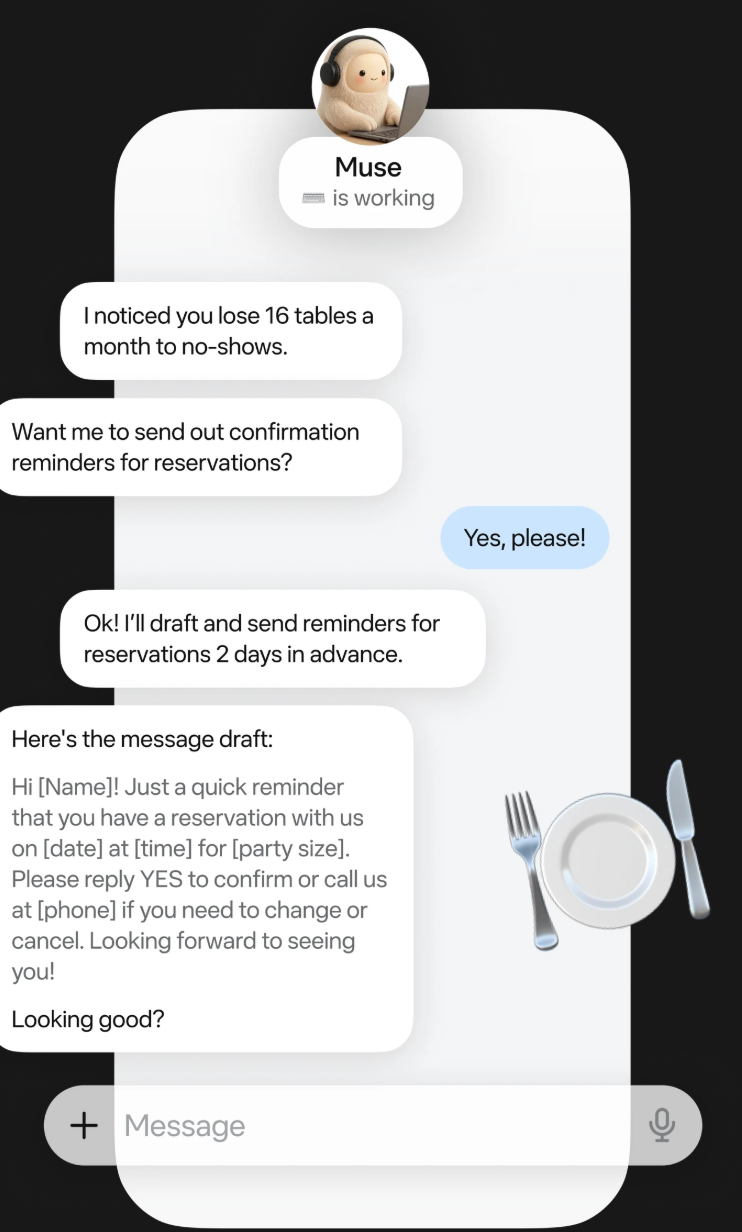
Meta’s own words matter here. Muse is positioned as a personal AI agent that “doesn’t just answer questions, it does the work,” expanded for small business with skills and connectors so owners can “get work done with the tools they already use.”
Published connector examples (list evolves, check Muse settings): Asana, Box, Canva, Dropbox, Figma, Granola, HighLevel, Intuit QuickBooks, Klaviyo, Lovable, Notion, Shopify, Slack, Stripe, Zoom, plus Facebook / Instagram business accounts and Meta ads.
Example jobs Meta highlights:
- Analyze a year’s sales, campaigns, and social, then draft a growth plan
- Triage email / calendar / news when you’re underwater
- Review ads and content performance, then draft next week’s campaign
- Review monthly financials for unusual expenses
Safety framing Meta emphasizes: nothing publishes, sends, or spends without approval; audit trail of what the agent did and plans to do.
None of that is fake. For a grocery owner, orchard, or Shopify shop already deep in Meta’s apps, an agent that speaks fluent Instagram analytics, ads, and connected books is genuinely useful. Our point isn’t “Muse is vapor.” Our point is what kind of company Muse assumes you already are.
What “orchestration” quietly requires
Orchestration layers inherit the shape of the system underneath.
If Muse connects to Shopify + QuickBooks + Canva + Slack + HighLevel + Stripe + Meta ads, someone still:
- Chose and pays for each of those products (or equivalents)
- Authenticated each connector and keeps credentials healthy
- Owns breakage when a sync lags, a schema changes, or two tools disagree on “the customer”
- Approves a stream of drafts that still need a human who understands the whole picture
- Learns enough of each app that the agent’s suggestions are checkable
That’s the Integration Tax with a smarter conductor. Indie Hackers and Reddit Frankenstack threads aren’t usually complaining that AI can’t draft a caption. They’re complaining that Tuesday disappears into logins, glue, and babysitting (see the Frankenstack piece).
Muse reduces some of that cognitive load. It does not, by design, remove the requirement that the orchestra exists. Meta says so plainly: built to work with tools people already use.
Runza’s bet for solos is the opposite starting point: don’t assemble the orchestra first. Put website, customers, money, and marketing where Ace can act without a connector safari.
Runza: be the stack, don’t conduct it
Ace is not “ChatGPT with a Runza skin,” and Ace is not “Muse but for people who hate Meta.” Ace is Runza’s AI co-founder who does the work: site, customers, invoicing, marketing, inside one product built for one-person companies.
| Job | Muse-shaped path | Runza path |
|---|---|---|
| Get a site live | Often: builder or Shopify/Lovable/etc. + Muse helping across it | Website lives in Runza; Ace helps ship it |
| Remember customers / follow-ups | CRM or HighLevel (or similar) + Muse drafts / triage | CRM in Runza; Ace helps you not drop Thursday |
| Get paid | Stripe / QuickBooks / invoicing tool + Muse on the books | Invoicing & quotes in Runza |
| Find & keep customers | Meta ads + Canva + Klaviyo/email + Muse drafting campaigns | Marketing in Runza with Ace executing alongside you |
| Ops brain | Agent spans dashboards you still maintain | One place |
Three products that get confused in 2026 AI-agent discourse:
- Orchestration agents (Muse-shaped): brilliant when the stack is real and the job is coordination.
- Another all-in-one dashboard you still configure (GHL / HubSpot / many “AI CRMs”): see our GHL and HubSpot fit checks.
- Ace: co-founder execution for the one-person company, not a conductor for eight SaaS seats.
If you left a Zapier glue pile because too many moving parts, adding an orchestration agent on top of a new glue pile can feel like progress while the bill and cognitive load stay structurally the same. The goal isn’t a prettier approval queue. It’s fewer tools that need approving in the first place, for the class of business that never needed agency-grade sprawl.
Honest “when Muse wins / when Runza wins”
- Your competitive edge already depends on deep Meta + commerce/creative tooling
- Replacing Shopify/QB/Canva would be irrational; you need a layer that uses them
- You have (or will hire) enough operational maturity to manage connectors and approvals
- Free-tier Muse usage covers the agent layer and you’re optimizing an existing stack, not escaping one
- You’re shopping agents because you’re drowning, and the drowning is tool count, not just task count
- You don’t have a Shopify + QB + Canva + Slack world yet, and you don’t want one as a prerequisite for AI help
- You want one subscription and one co-founder workflow for the jobs that keep a solo business alive
- You’ve already felt the “isn’t GHL / HubSpot / Systeme enough?” trap: powerful software that still leaves you as the integration layer
Both can coexist in theory (Muse on Meta ads while Runza runs ops), but if your reason for Muse is “I need something to finally run the company,” start by asking whether the company needs eight runtimes or one. Don’t buy an orchestra so the conductor has a job.
Cost: Muse sticker vs the real bill
Meta markets Muse as free for most of what people need, with paid plans when you want more usage. That sentence is true for the agent line. It is incomplete if you treat it as the cost of running a small business with Muse.
Rule for this compare: never price Muse against Runza as Free vs $69. Price Muse agent plus the stack Muse connects to plus ads/fees plus soft costs against one Runza plan that is the stack for solos, plus Runza’s own card fee (1% per sale on top of Stripe’s processing fee) when customers pay you by card.
Layer 1: Muse the agent (published subscription tiers)
| Muse plan | List price | What you get |
|---|---|---|
| Free | $0 | Usage-capped. Hit the limit, upgrade or wait until free usage refreshes |
| Power | $20/mo | 500M Muse tokens / week |
| Maximum | $100/mo | 3B Muse tokens / week |
Subscriptions renew monthly unless canceled. Muse for Small Business is available in the US and Canada for adults 18+. So the agent line is often $0 to $20, sometimes $100 if you’re heavy. For most solopreneurs, that line is not where the money goes.
Layer 2: the connector stack Muse assumes you already run
Muse for Small Business is built to work with tools people already use. Published connector examples include Asana, Box, Canva, Dropbox, Figma, Granola, HighLevel, Intuit QuickBooks, Klaviyo, Lovable, Notion, Shopify, Slack, Stripe, Zoom, plus Facebook / Instagram business accounts and Meta ads. Those products keep their own bills.
| Connected tool | Solo-ish list price | Extra / usage |
|---|---|---|
| Shopify Basic | ~$29/mo yearly or ~$39/mo monthly | Card rates ~2.9% + 30¢ (plan-dependent); apps; themes |
| QuickBooks Online | $20 Solopreneur to $35 Simple Start to $70 Essentials+ | Payroll add-ons; payment processing on invoices |
| GoHighLevel Starter | $97/mo | SMS, phone numbers, email sends, premium AI: the classic “sticker ≠ bill” tax |
| Klaviyo Email | Free ≤250 profiles, paid from ~$20/mo at ~500 profiles | SMS / WhatsApp / add-ons billed separately |
| Canva Business | $250/year per person (~$21/mo) | AI usage caps; seats if you add help |
| Slack Pro | ~$8.75/active user/mo monthly | Free tier exists; Business+ higher |
| Notion Plus | ~$10/member/mo annual | Free tier exists; Business higher |
| Stripe | $0 platform fee | Standard online cards often ~2.9% + $0.30 |
| Meta ads | Not SaaS, ad spend | If Muse drafts “next week's campaign,” impressions still cost real dollars |
Read this table correctly: you will not buy every row. Muse’s demo shape of a connected small business often implies several of them. The agent does not cancel those subscriptions when you connect them. It requires them to have somewhere to operate.
Layer 3: three illustrative monthly pictures (SaaS only, before ads & card %)
These are scenarios, not invoices. They show why “Muse is free” is the wrong headline for a solopreneur cost compare.
A. Lean local / service solo (no Shopify, no HighLevel)
Muse Power $20 + QuickBooks Simple Start $35 + Canva Business ~$21 + Slack/Notion free or ~$10
Roughly $75 to $100/mo SaaS before Stripe % on invoices and any Meta ad spend. The agent is a slice. The books and design stack is the meal.
B. “Connected small business” commerce-ish (Meta’s connector story without GHL)
Muse $20 + Shopify Basic ~$39 + QuickBooks $35 to $70 + Klaviyo $20 to $45 + Canva ~$21 + Slack ~$9
Roughly $145 to $200+/mo SaaS, then Meta ad spend plus card fees on store revenue. Still no HighLevel.
C. Agency-shaped stack Muse explicitly connects
Scenario B + HighLevel $97 (+ SMS/phone/email usage)
Roughly $250 to $350+/mo software before ads. Muse at $20 is rounding error next to GHL + Shopify + email.
Compare posture vs Runza: Runza Pro is currently $69/mo for the company OS (see /pricing): website, customers, invoicing, marketing with Ace, Runza’s AI co-founder who does the work, in one place. We do not claim $69 beats a $0 DIY forever (Notion + Carrd can be under $50/mo). We claim: if your alternative is Scenario B or C so an orchestration agent has a job, one plan that is the stack is the honest apples-to-apples for many one-person companies. One honest addition to that math: when customers pay you by card in Runza, Runza takes 1% of each sale on top of Stripe’s standard processing fee (pricing). So the Stripe row above doesn’t disappear with Runza. It gets 1% bigger.
Layer 4: soft costs that never appear on Muse’s upgrade screen
- Connector babysitting: expired OAuth, sync lag, “which system is source of truth for the customer?”
- Approval-queue time: Meta’s safety model is good; volume of drafts still scales with how many apps you connected
- Duplicate AI spend: Canva AI + Klaviyo Composer + HighLevel AI + Muse tokens overlapping the same caption/campaign jobs
- Learning tax: enough fluency in each connected app to check the agent (orchestration without audit skill is gambling)
- Geography / eligibility: Muse US/Canada 18+ today; your stack tools may be global while the conductor isn’t
Muse lock-in = Meta-ecosystem gravity plus habit of paying N SaaS seats so the agent stays useful. Runza lock-in = “your ops live here.” Prefer the lock-in that matches the business you actually run: one person who shouldn’t need an orchestra, not a mini-agency that already has one.
Bottom line: Muse’s clever move is low agent sticker, high stack gravity. The honest question is not “Is the AI free?” It’s “Am I paying for a conductor, or am I still paying for the whole orchestra, and did I want an orchestra?”
Try Ace on your real business
If your Tuesday still looks like logging into everything so an agent has something to orchestrate, try the other shape: one place, Ace doing the work with you.
Start with Runza · see why Runza · pricing · full compare hub