The Post-Software Era: Why the Next Great Business Tool Isn't Software at All
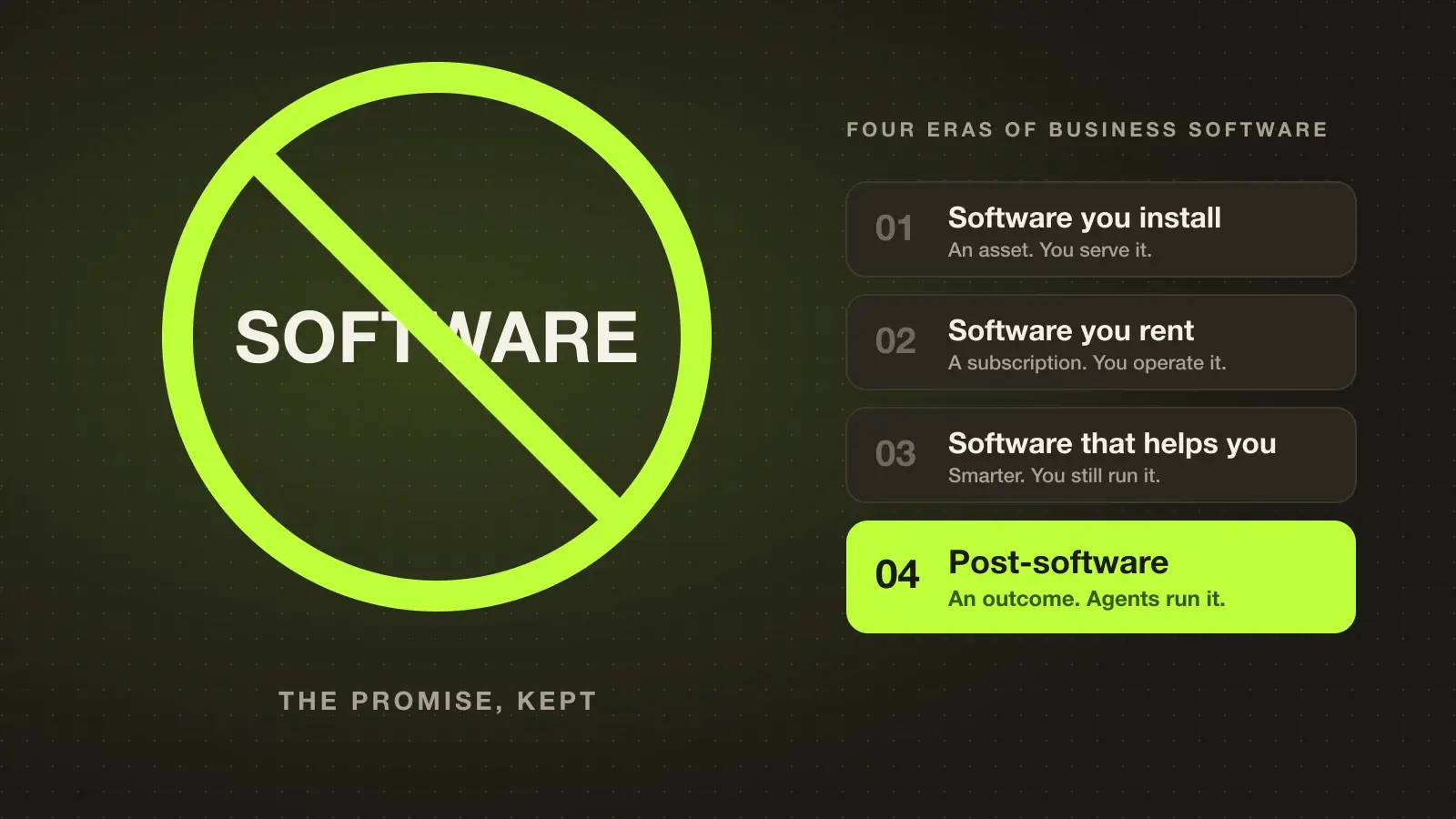
In 1999, a young company ran a marketing campaign built around a red circle with a line through the word “software.” The promise was bold: no more installs, no more servers in the closet, no more version 4.2 patches shipped on a CD. That company was Salesforce, and the campaign helped launch the cloud era.
There’s a quiet irony in it. “No Software” didn’t actually mean no software. It meant software you rent instead of software you own. You still had to learn it, configure it, feed it data, connect it to everything else, and log in every day to make it do anything.
Here’s the uncomfortable proof. In 2024, a survey of US businesses with five or fewer employees found that 62% of owners work more than 50 hours a week. That’s exactly the same share a Wells Fargo/Gallup poll found in 2005. Twenty years of cloud software, thousands of new apps, and the people who run small businesses aren’t working a single hour less.
Owners aren’t working a single hour less.
Thousands of new apps later, the share of owners working 50+ hour weeks hasn’t moved.
Twenty-five years after that red circle, we’re finally about to keep the promise. Not with better software, but with no software to run at all.
- 01Software you installSoftware is an asset. You serve it.
- 02Software you rentSoftware is a subscription. You operate it.
- 03Software that helps you run softwareSoftware is smarter. You still run it.
- 04The Post-Software EraSoftware is an outcome. Agents run it.
Software you install
The first era of business technology was about ownership. You bought a license, you installed it on machines you managed, and you hired people to keep it alive. Accounting packages, ERPs, CRMs, and scheduling systems all lived on premises.
The value was real. Businesses that used to run on paper ledgers suddenly had databases. But the cost was hidden in everything around the license: the servers, the IT staff, the upgrade projects that took a year, the consultants who knew where the bodies were buried.
In this era, software was an asset, and the business served the software as much as the software served the business.
For the small business, the message was simple: this isn’t for you. The plumber, the groomer, the caterer, the solo consultant ran on a notebook, a phone, and memory.
Software you rent
The cloud changed the economics. No installs, no servers, pay by the month. Software became a utility, and SaaS became the default way businesses bought tools.
This opened the door for small businesses for the first time. Suddenly there was an app for everything:
- a website builder
- a booking tool
- a payment processor
- an invoicing app
- a CRM
- an email marketing tool
- a forms tool
- a scheduling tool, a review tool, a text messaging tool…
Each one is good. Each one is affordable on its own. That’s the trap.
The cloud didn’t remove the work of running software. It distributed it. Instead of one big system managed by an IT department, the small business owner became the IT department for ten small systems. Logins, integrations, settings, renewals, and the constant low-grade question of “which app is this in again?”
department
Even companies with full IT departments can’t keep up. The average company now runs 305 SaaS apps, and in a typical month nearly half of its licenses go unused. SaaS spend hit $4,830 per employee in 2024, up almost 22% in a single year. If the professionals are drowning, imagine the groomer running her business from her phone between appointments.
SaaS apps the average company now runs
of licenses go unused in a typical month (54% utilization)
SaaS spend in 2024, up almost 22% in one year
For small business owners, the cost shows up in hours. Entrepreneurs report spending 36% of their workweek on small administrative tasks like invoicing and data entry. Among the smallest businesses, the median owner works 60 hours a week, and admin plus legal and compliance eats 22.4% of it. That’s 79% more time than they spend on marketing and sales, the work that actually grows the business.
Admin gets 79% more time than the work that grows the business.
In this era, software was a subscription, and the business owner became its unpaid operator.
That’s the hidden tax of SaaS: the tools are cheap, but running them is expensive, and the person paying it is the owner’s time.
Software that helps you run software
The arrival of capable AI models kicked off the current era, and most of the industry has responded the same way: bolt AI onto the existing app. Every product now has a sparkle button. Write my email. Summarize this record. Suggest a reply. Generate a landing page.
Call it the agent-assisted era. It’s genuinely useful, and it’s also a dead end for small businesses, because it optimizes the wrong thing. It makes each tool slightly faster to operate while leaving the fundamental problem untouched: there are still ten tools, and a human still has to run them.
An AI copilot inside your booking app doesn’t know what’s in your invoicing app. The assistant in your website builder doesn’t know that a client just paid a deposit. Agentic workflows strung together with automations help, but someone still has to design them, maintain them, and fix them when one link in the chain breaks at 9 PM on a Friday.
The analysts are starting to say it too. Gartner predicts that more than 40% of agentic AI projects will be canceled by the end of 2027, citing escalating costs and unclear business value. It warns about “agent washing,” the rebranding of chatbots and assistants as agents, and estimates that only about 130 of the thousands of vendors claiming agentic AI are the real thing. Its advice is telling: bolting agents onto legacy systems is complex and disruptive, and the better path is often rethinking the workflow from the ground up.
of agentic AI projects will be canceled by the end of 2027.
Escalating costs, unclear business value.
of the thousands of vendors claiming agentic AI are the real thing.
The rest is “agent washing.”
Rethinking it from the ground up is the whole point.
In this era, software got smarter, but it’s still software, and someone still has to run it.
The Post-Software Era
Here’s the shift that’s happening now, and it’s bigger than it sounds.
The question has always been “Which software should I use to run my business?” The new question is “Why am I running software at all?”
In the Post-Software Era, the business owner doesn’t adopt tools. They describe the business they want, and agents build it, run it, and keep it running. The website, booking, payments, client records, follow-ups, and the back end connecting all of them aren’t apps you log into. They’re outcomes that agents deliver and maintain.
That’s the line between the last era and this one:
- Agent-assisted: AI helps you operate your software.
- Agent-run: AI replaces the software you’d otherwise operate.
AI helps you operate your software.
Ten tools, ten copilots, still one human running them.
AI replaces the software you’d otherwise operate.
It’s the difference between a smarter steering wheel and not needing to drive.
Why this happens now
Three things had to be true at once, and for the first time they are:
- Agents can build, not just talk. Today’s AI can generate working systems: pages, forms, databases, logic. That turns “build me a booking flow” from a project into a request.
- Agents can maintain, not just create. The hard part of software was never day one. It was day 400. Agents that can monitor, adjust, and fix what they built change the cost of ownership entirely.
- The business context can live in one place. When the website, bookings, payments, and client history all come from one system, an agent can actually understand the business instead of guessing across ten disconnected apps.
And it’s arriving fast. Gartner expects that by 2028, 33% of enterprise software applications will include agentic AI, up from less than 1% in 2024, and that at least 15% of day-to-day work decisions will be made autonomously, up from zero. Enterprises will get there by retrofitting. Small businesses don’t have to. They can skip straight to agent-run.
Enterprise apps with agentic AI
Day-to-day work decisions made autonomously
What it looks like in practice
Picture a dog groomer, a tattoo artist, or a caterer starting today.
In the SaaS era, their first month looks like this: pick a website builder, pick a booking tool, connect payments, set up a CRM, figure out email, wire it all together, and hope nothing breaks.
In the Post-Software Era, it looks like this: they tell an AI co-founder about their business, what they offer, how they price it, how clients should book, and what they want to get paid up front. The site goes live. Booking works. Payments work. Client records fill in on their own. Follow-ups go out. When they want to change something, they say so, and it changes.
- 1Pick a website builder
- 2Pick a booking tool
- 3Connect payments
- 4Set up a CRM
- 5Figure out email
- 6Wire it all together
- 7Hope nothing breaks
- The site goes live
- Booking works
- Payments work
- Client records fill in
- Follow-ups go out
They never chose a tool. They never configured an integration. They never became the IT department.
That’s what we’re building at Runza. Ace, Runza’s AI co-founder, doesn’t sit inside a stack of apps helping the owner push buttons. Runza builds and manages the whole back end itself, so the owner gets to spend their time on the work they actually started the business to do.
What this means for the software industry
Every era rewards a different kind of company.
- The on-premise era rewarded companies that owned the install.
- The cloud era rewarded companies that owned the subscription.
- The agent-assisted era is rewarding companies that add AI to the interface.
- The Post-Software Era will reward companies that own the outcome.
That’s an uncomfortable shift for an industry built on seats, logins, and feature lists. If the customer never logs in, the dashboard isn’t the product. If agents connect everything, the integration marketplace isn’t a moat. If the business just works, the product is no longer the software. It’s the result.
For incumbents, the instinct will be to defend the interface: more AI features, more copilots, more buttons with sparkles on them. For small businesses, that’s just a faster way to keep running ten tools.
The promise, kept
The 1999 campaign promised “No Software.” What it delivered was software somewhere else.
The Post-Software Era delivers on the original promise for the people who needed it most: the solo operator, the small shop, the business owner who never wanted to be a software administrator in the first place.
The next great business tool won’t be a better app. It’ll be the absence of apps, and an agent that runs the business back end so the owner doesn’t have to.
We’re not making software easier to run. We’re making it unnecessary to run.
Keep reading
Sources
- UENI, survey of 837 US businesses with 5 or fewer employees (May 2024)
- Time etc / Censuswide survey of 251 US entrepreneurs (2023), via Forbes
- Zylo 2026 SaaS Management Index (305 apps, 54% license utilization)
- Zylo 2025 SaaS Management Index ($4,830 per employee, up 21.9%)
- Gartner, June 25, 2025
- Reuters on “agent washing”